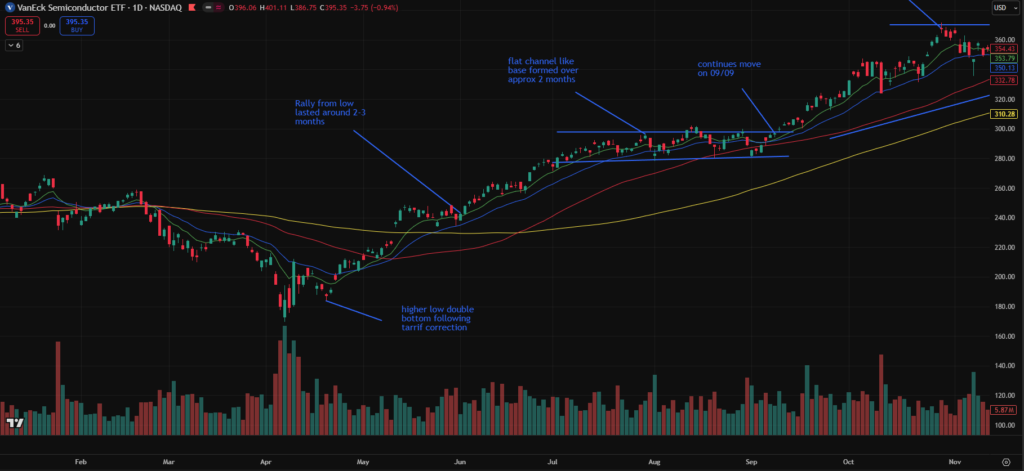
Following a higher-low double bottom formation after the 2025 tariff correction, the semiconductor space staged a strong 2–3 month rally before entering a flat channel consolidation from July through early September.The sector resumed its upward trend around September 9th.
Below are several setups that emerged during the September–October leg of the move.
Notably, many of the largest percentage gainers during this period were not traditional semiconductor manufacturers, but companies focused on computer memory and storage — areas experiencing elevated demand due to AI infrastructure expansion and closely tied to the broader semiconductor ecosystem.
SNDK
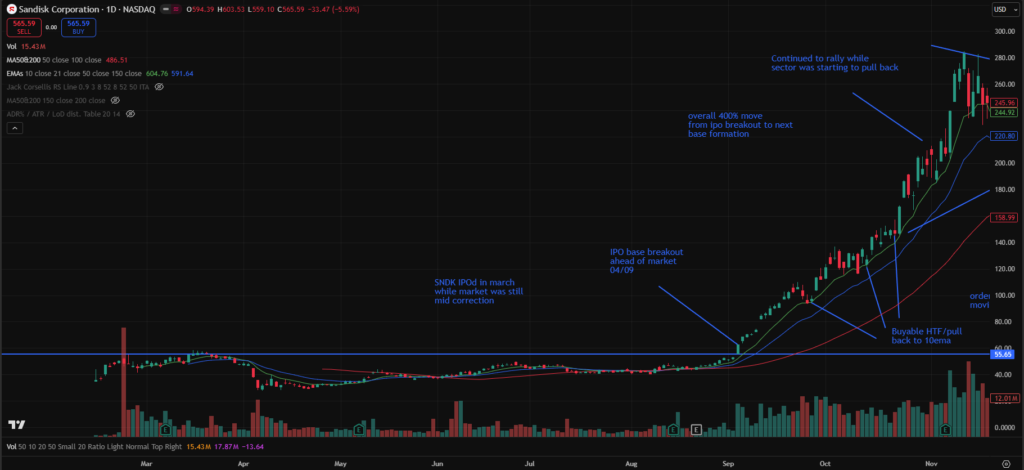
SNDK IPO’d during the tariff correction and formed a roughly six-month IPO base. On 04/09, it broke out ahead of the broader semiconductor sector on the highest volume since its IPO — an early sign of institutional demand.
Throughout its subsequent 2–3 month (~400%) advance, SNDK provided multiple buyable pullbacks to the 10EMA and brief high-tight flag (HTF) formations. Its early relative strength acted as a leading indicator for the broader sector move and offered several high-probability entry opportunities as the group gained momentum.
MU/MUU
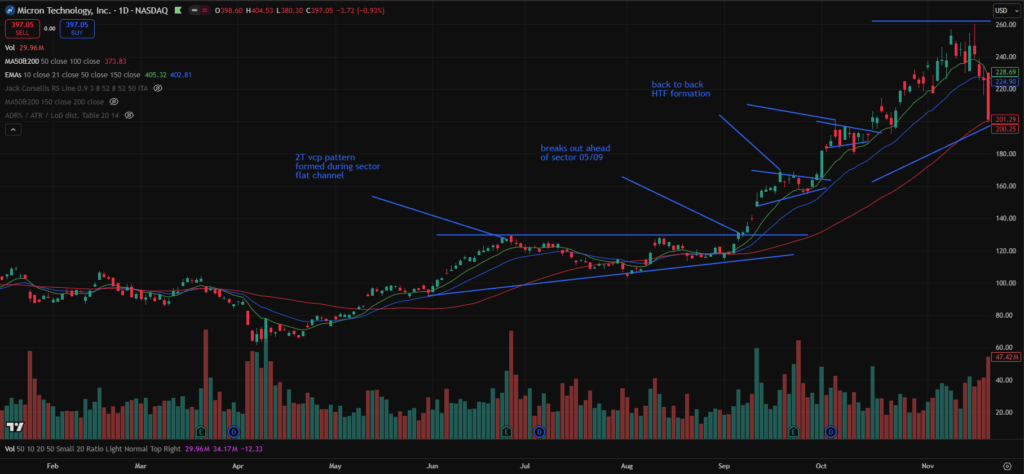
While the broader sector was forming a flat channel base, MU constructed a 2T VCP/cup-with-handle pattern — a clear signal of relative strength and volatility contraction. It broke out of this structure on 05/09, again ahead of the broader market.
From that breakout, MU formed two clean, buyable high-tight flag/pullback structures along its two-month advance (~100% for MU, ~270% for MUU). The ability to tighten and break out while the sector was still basing was a strong leadership characteristic.
WDC
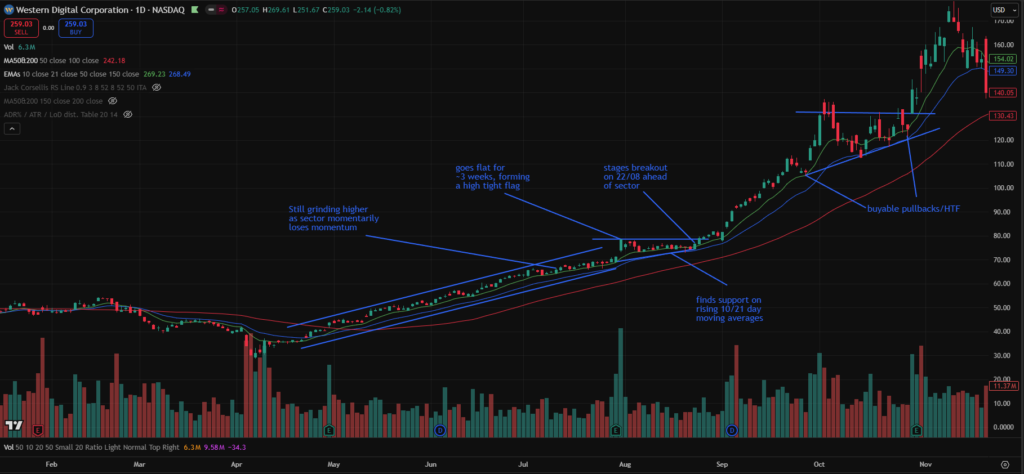
During July, when much of the semiconductor sector was trading sideways, WDC continued grinding higher, printing higher highs and higher lows. After a brief sideways consolidation to the 10/21-day moving averages in early August, it resumed its uptrend on 22/08.
Like MU, it offered multiple constructive pullbacks before eventually forming its next longer-term base.
AXTI
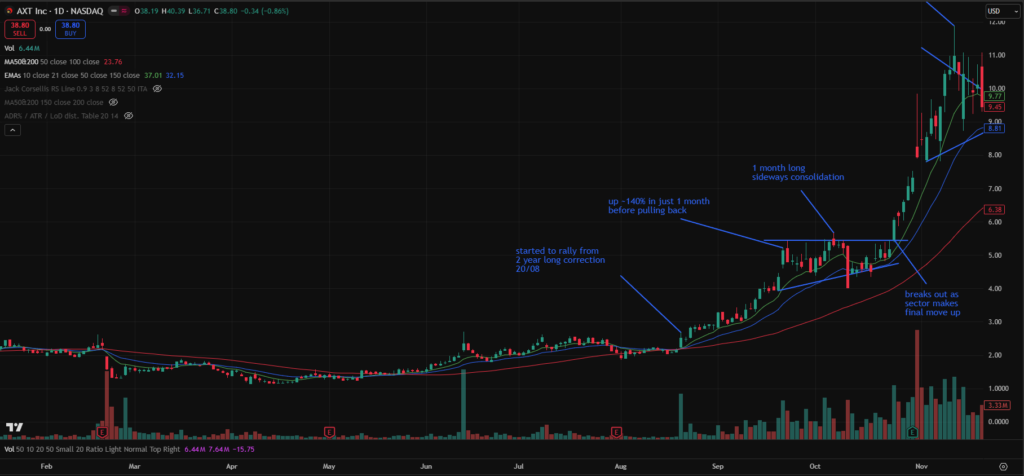
AXTI began advancing off the lows of a 2.5-year consolidation on 20/08. Within approximately one month, it rallied over 140% before pulling back to the 10/21-day moving averages and forming a high-tight flag.
On 24/10, it broke out from that structure as the broader sector was completing the final leg of its move. From this breakout, it advanced another ~120%.
Conclusion & Key Takeaways
One notable observation from this rally is that many of the strongest performers were not pure-play semiconductor manufacturers, but companies operating in adjacent areas such as memory and storage. With increased demand for high-performance computing driven by AI infrastructure, many adjacent industries also saw significant capital inflows. This highlights the importance of understanding sector interconnectivity rather than viewing industries in isolation.
Another consistent theme across these names was early relative strength. Subtle but repeatable signals appeared before the broader sector confirmed its breakout, including
- Holding higher lows while the sector printed equal or lower lows
- Advancing on days when the sector was flat or weak
- Breaking out of consolidation ahead of the broader group
- Volatility contraction patterns forming while the index was still basing
These characteristics often serve as early indicators of leadership and can provide advance notice of potential sector-wide expansion.
Ultimately, this rally reinforces a broader principle: sector moves are rarely random, and often have very repeatable behaviour. In my experience, sector moves often follow a structure similar to the one below
- Leadership emerges early, showing relative strength and often breaking from consolidation ahead of the broader market
- Volatility contracts across the broader sector as a clean base forms
- As the broader sector sets up, the leaders often present secondary entry points
- A breakout is seen in the broader sector with broad participation amongst laggards.
The key is maintaining awareness of relative strength and being prepared to act when constructive setups align with improving sector momentum.